 Ningyuan Fastener
Nylon Screws are becoming practical alternatives to metal fasteners in electronics, appliances, renewable-energy equipment, and lightweight assemblies. Their appeal is clear: low weight, electrical insulation, corrosion resistance, and reduced surface damage. Grand View Research estimates that the global nylon market reached approximately USD 31 billion in 2022 and may expand at about 5.8% annually through 2030. That growth does not automatically mean every nylon screw suits every application. Selection still depends on load, temperature, thread design, and chemical exposure.
Small parts matter.
Industry buyers often begin with material labels, but experienced engineers look deeper. PA66 may provide better strength and heat resistance than standard PA6, while reinforced grades can improve dimensional stability. However, glass-filled nylon may increase stiffness while reducing impact tolerance. That trade-off is easy to miss. Reports from MarketsandMarkets on engineering plastics also highlight rising demand for lightweight, high-performance polymer components across transportation and electrical industries. Yet market forecasts are not product approvals. A screw used near a motor, battery enclosure, or outdoor control panel needs application-specific validation.
This guide examines ten common types of Nylon Screws, including pan-head, countersunk, hex, and self-tapping designs. It compares their thread behavior, installation limits, insulation value, and typical purchasing uses. Testing should include torque, pull-out strength, temperature cycling, and chemical contact where relevant. Standards such as ISO 9001 quality systems and UL flammability evaluations can support supplier assessment, but neither replaces engineering judgment. Some recommendations remain conditional. Real assemblies often expose weaknesses that catalog specifications do not show.
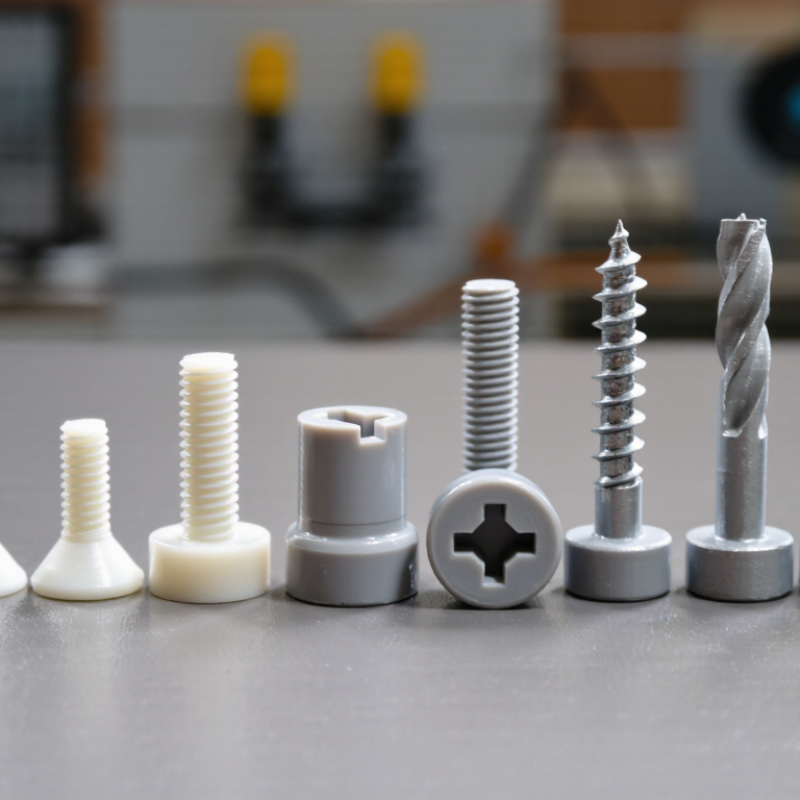
For global buyers comparing nylon screws, PA6 and PA66 should be read through ASTM D4066 classification data, not only through catalog labels. PA6 typically melts near 220°C, while PA66 approaches 260°C. Their density is similar, around 1.13–1.15 g/cm³, according to polymer data compiled in CAMPUS and engineering material databases. PA66 usually keeps higher stiffness near heat, but PA6 often absorbs impact energy more effectively.
Moisture changes the result. Dry PA6 and PA66 can show strong tensile performance, yet absorbed water may reduce stiffness and alter thread fit. ASTM D4066 therefore supports grade-based comparison, including reinforcement and conditioning details. A screw tested dry may not represent one installed beside a humid pump.
PVDF is different. It is a fluoropolymer, not a nylon grade, so ASTM D4066 is not the correct classification framework. Typical PVDF density is about 1.75–1.80 g/cm³, with a melting range near 170°C, based on technical data summarized by the CAMPUS database and fluoropolymer material reports. It offers strong chemical resistance, but its lower melting range demands careful installation torque and temperature control.
The practical mistake is treating “higher temperature” as the only buying signal. A PA66 screw may suit a warm dry enclosure, while PVDF may perform better around aggressive chemicals. Verify ASTM test conditions, moisture state, thread design, and actual service temperature before selecting among the top ten screw types.
| No. | Screw Type | Typical Drive / Head | Common Material Options | Indicative Application | Key Selection Consideration | ASTM D4066 Relevance |
|---|---|---|---|---|---|---|
| 1 | Pan Head Machine Screw | Phillips, slotted, or combination drive | PA6 or PA66; PVDF for demanding chemical environments | General electrical assembly, control panels, light equipment enclosures, and non-structural fastening | Provides a broad bearing surface with a low-to-medium profile. Select a larger diameter or metal insert when higher clamp load is required. | Applicable to PA6 and PA66 resin classifications when the supplied resin grade is covered; not a screw dimensional standard. |
| 2 | Flat Countersunk Screw | Phillips, slotted, or hex socket drive | PA6, PA66, or PVDF | Flush-mounted covers, housings, instrument panels, and assemblies where protruding heads are undesirable | Requires a correctly matched countersink angle and controlled tightening torque. The head can be more sensitive to over-tightening than a pan head. | PA6 and PA66 may be classified under ASTM D4066; PVDF is outside ASTM D4066 because D4066 is a nylon classification system. |
| 3 | Oval Countersunk Screw | Phillips or slotted drive | PA6 or PA66; PVDF where chemical resistance is prioritized | Decorative covers, electrical faceplates, and applications requiring a partially rounded visible head | Offers a smoother appearance than a flat countersunk head while retaining a partially flush installation. | For PA6 and PA66, verify the resin classification and grade documentation; ASTM D4066 does not define the finished screw geometry. |
| 4 | Socket Head Cap Screw | Internal hex socket | PA66 commonly selected for higher temperature capability; PA6 for general-duty use | Machinery guards, fixtures, laboratory equipment, and assemblies with limited tool access | The internal socket supports controlled installation, but the allowable torque remains substantially lower than for steel screws of the same nominal size. | ASTM D4066 can support classification of the nylon resin used in PA6 or PA66 components, not torque ratings or socket dimensions. |
| 5 | Hex Head Screw | External hexagonal head | PA6, PA66, or PVDF | Through-bolting, cable support systems, access covers, and installations requiring a wrench | Easy to install with an open-end or socket wrench. Use a washer or flange when the mating surface is soft or the bearing area is limited. | ASTM D4066 is relevant only to a qualifying nylon resin grade; it does not establish the screw's head, thread, or dimensional requirements. |
| 6 | Hex Washer Head Screw | External hex drive with integrated washer face | PA6 or PA66; PVDF for high chemical exposure | Sheet assemblies, electrical cabinets, plastic panels, and fastening over slotted or oversized holes | The integrated bearing flange spreads load and can reduce pull-through in softer substrates compared with a standard hex head. | PA6 and PA66 resin classifications may be referenced under ASTM D4066; the standard does not certify pull-through performance of the finished screw. |
| 7 | Shoulder Screw | Socket head or slotted head with an unthreaded shoulder | PA66 for general mechanical service; PVDF for chemical exposure | Low-load pivots, rollers, spacers, guides, and insulating hinge points | The unthreaded shoulder provides a defined bearing surface. Confirm shoulder diameter, length, concentricity, and clearance before ordering. | ASTM D4066 may describe the nylon resin family and grade; it does not define shoulder-screw geometry or bearing-life performance. |
| 8 | Thumb Screw | Knurled, slotted, or wing-style hand-operated head | PA6 or PA66; PVDF for corrosive environments | Tool-less access panels, battery covers, laboratory fixtures, and removable guards | Designed for hand tightening and repeated access. It is generally unsuitable where a high, precisely controlled preload is needed. | ASTM D4066 may apply to the PA6 or PA66 material classification, but it does not specify hand-tightening force or ergonomic head design. |
| 9 | Wing Screw | Integrated wings for hand tightening | PA6 or PA66; PVDF in selected chemical-processing applications | Frequent-access covers, inspection doors, temporary fixtures, and low-load clamping points | Provides rapid tool-free installation. Wing dimensions and polymer toughness should be checked for repeated use and cold-temperature service. | If manufactured from nylon, the resin may be classified under ASTM D4066; PVDF is not classified by this nylon-specific standard. |
| 10 | Self-Tapping Thread-Forming Screw | Pan, flat, or hex head with pointed or thread-forming tip | PA6 or PA66; PVDF when chemical compatibility is the primary requirement | Plastic housings, thin polymer panels, cable-management components, and low-load assemblies | Thread design, pilot-hole diameter, installation torque, and boss geometry strongly affect pull-out and strip resistance. Validate the joint in the actual substrate. | ASTM D4066 can classify the nylon resin, but it does not establish thread-forming geometry, pilot-hole size, or joint performance. |
Dry, unfilled PA66 often shows tensile strength near 75 MPa. Published values commonly range from 70 to 85 MPa. This is only a material reference. Finished screws may perform differently.
No. It tests standardized plastic specimens. Screw threads, molding quality, and installation torque affect actual performance. That distinction is easy to miss.
PA66 absorbs moisture from humid air and storage areas. Moisture can reduce stiffness but improve toughness. A warehouse sample may differ from a dry laboratory sample.
PA66 melts near 255–260°C, but screws need much lower service temperatures. Long exposure above about 100°C can reduce preload retention and creep resistance. Short heat resistance is not continuous-load performance.
Confirm diameter, pitch, length, head dimensions, and thread engagement. An “M4” marking alone may not specify the pitch or tolerance. Small drawings create large assembly problems.
UNC threads use a coarser pitch. UNF threads use a finer pitch. They should not be substituted casually.
Pan, flat, round, hex, socket, shoulder, thumb, self-tapping, machine, and captive types are common. Choose based on clearance, access, load, and panel design. Head shape matters.
Request material specifications, test reports, supplier declarations, and traceable batch information. Review restricted substances in the nylon, colorants, additives, and metal inserts. A generic compliance statement may be outdated.
Compare samples with the approved drawing and use a thread gauge. Check dimensions, thread condition, torque retention, creep, and deformation. I would retest the actual screw design.
Nylon Screws come in a wide range of configurations suited to electronics, machinery, insulation, automotive components, and general assembly. This guide explains how PA6, PA66, and PVDF grades differ under ASTM D4066, including their balance of strength, chemical resistance, moisture absorption, and temperature performance. It also reviews ten practical screw types classified by head style, thread form, and application, helping buyers select the right option for fastening, spacing, mounting, or insulating tasks. PA66 is highlighted for higher mechanical performance, with tensile strength around 75 MPa when evaluated according to ASTM D638, while grade selection should always match the working environment.
For international purchasing, dimensional compatibility is essential. Buyers should confirm ISO 261 metric threads or UNC/UNF thread standards, along with RoHS and REACH compliance documentation where required. A complete evaluation should also cover allowable torque, dimensional tolerance, minimum order quantity, lead time, packaging, inspection procedures, and total cost. Considering these factors together can reduce assembly risks, improve supply planning, and support consistent quality across global applications.
